
Opinion: Is Change Management the Missing Link in Your Growth Strategy?
Is Change Management the Missing Link in Your Growth Strategy?
Opinion by Louis Kreuzpeitner, Senior Organisational Change Management (OCM) Lead, Arcondis
In boardrooms around the world, change management is still often treated as an “afterthought” – something to “layer on” after the technology is selected, the budget approved and the plan in motion. But in today’s world, where transformation is the rule rather than the exception, this mindset is a critical and costly mistake.
Organisational Change Management (OCM) is designed to guide companies through transformation and change. It’s about strategic execution. It’s the difference between a project that simply goes live and one that delivers real, measurable impact. Without it, even the most well-funded, technically sound initiatives will fall short, hampered by resistance, poor adoption, and underwhelming results.
Download this Article as a PDF
OCM isn’t just about managing change, it is about leading change. It is also about turning disruption into growth and revenue.
THE HIDDEN COSTS OF IGNORING CHANGE MANAGEMENT
Ignoring OCM can result in significant hidden costs, especially when changes heavily impact people. Prosci’s research shows that projects without structured change management realise only 27% of expected benefits, compared to 95% when change is effectively managed – highlighting the financial risks of neglecting the human side of change. In healthcare, a JACR study found that poor staff preparation for AI adoption leads to inefficiencies and delays, reinforcing the need for proactive change management to protect both performance and return on investment.
Hidden Costs of Ignoring Change Management:
1 Low Employee Adoption
When change management is overlooked, employees often fail to adopt new systems, tools, or processes. This results in organisations spending a considerable amount of time and money on initiatives that never reach their full potential.
2 Productivity Loss
Change can cause confusion and disruption in day-to-day operations if it isn’t managed properly. Employees unsure of new expectations or workflows spend time seeking clarity or making mistakes, which reduces overall efficiency. This drop in productivity can be temporary, but if left unchecked, it creates long-term performance issues that slow down the business and erode value.
3 Increased Turnover
Without a structured approach to managing change, employees often feel unsupported or left out, leading to frustration and dissatisfaction. This can result in higher turnover, especially among high performers who may seek more stable and engaging work environments elsewhere.
4 Decline in Morale and Engagement
Unmanaged change tends to breed uncertainty, scepticism, and resistance. Employees may feel overwhelmed, left behind, or excluded from the process, which diminishes morale.
5 Damage to Customer Experience
When internal changes are not well managed, the ripple effects often reach customers. Employees who don’t fully understand or embrace new systems or service models may deliver inconsistent or poor customer experiences.
6 Rework and Delays
Change initiatives that lack direction and stakeholder alignment will frequently encounter setbacks. Teams may implement changes incorrectly or incompletely, requiring costly rework or causing delays in delivery.
7 Missed ROI
Every change initiative is undertaken with a return on investment in mind – be it cost savings, efficiency gains, or improved performance. However, when change management is not applied, those benefits often fail to materialise.
8 Reputational Risk
Failed change initiatives can damage more than internal performance – they can hurt the organisation’s reputation. High-profile project failures, especially in areas like digital transformation or compliance, may be viewed as mismanagement by customers, investors, and industry peers. This can reduce stakeholder confidence, weaken the company’s market position, and make future change efforts more difficult.

THE ROI OF DOING IT RIGHT
It has been proven that companies that focus on OCM see better results. By involving stakeholders, providing training that fits specific needs, and communicating strategically and anticipating issues and concerns, they transition faster. They also make better use of new systems, which boosts project success and increases their investment returns (Bewaji Health, 2023).

Research and industry standards clearly show that companies managing change well are more likely to reach their goals and meet revenue targets. For instance, projects that include strong change management practices can be up to six times more successful than those that do not (SSP Innovations, 2022).
One example is a case study by Prosci, which demonstrates how Texas Children’s Hospital effectively implemented a hospital-wide electronic medical records system. This success was due to excellent leadership support and well-organised change activities (Prosci, 2023).
The KPMG Global Tech Report 2023 says that when healthcare and life sciences companies apply structured OCM practices, they see quicker digital growth. These companies also improve teamwork across various departments and ensure their strategic goals align well with the outcomes of their projects.
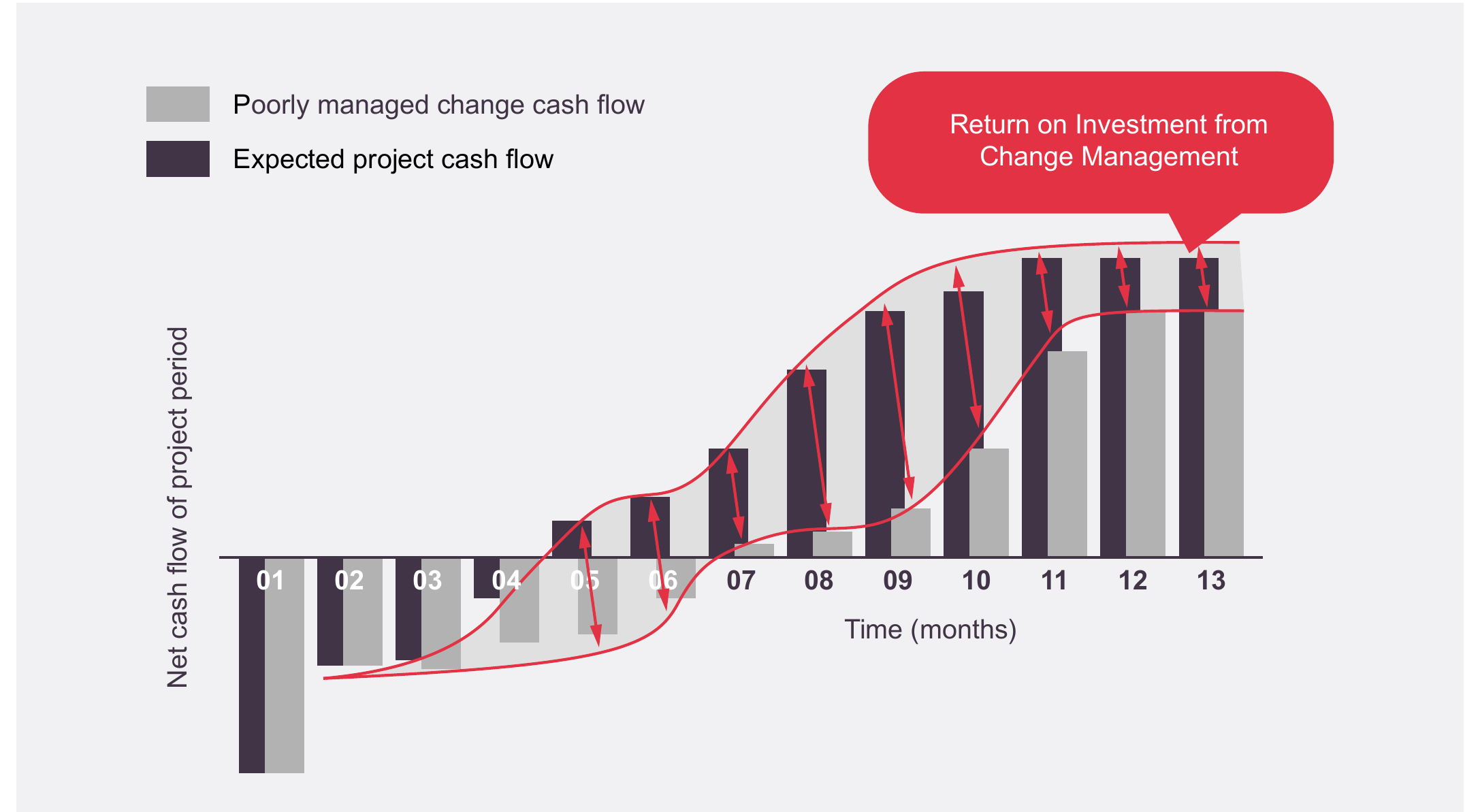
Figure 1: Return of Investment from Change Management (Source: Prosci® ROI of Change Management Model - adapted). The speed of adoption directly affects cash flow generated from the new solution (how soon savings are made, old systems turned off and projects closed).

LIFE SCIENCES: WHERE CHANGE IS HIGH-STAKES
Nowhere is change management more critical than in life sciences. This is an industry defined by complexity – scientific, technological, and regulatory. Transformation must balance innovation with compliance, efficiency with patient safety, and speed with precision.
At Arcondis, we specialise in helping life sciences organisations navigate this terrain. In our “Life Sciences 4.1” initiative, we helped companies to modernise their operations through process automation, digital strategy, and customer engagement while maintaining strict regulatory compliance. Success came not from the tools alone, but from managing how people adopted them.
In another instance, we saw firsthand how lack of early stakeholder alignment nearly derailed a global transformation effort. Change initiatives began too late, leaders were misaligned, and employee resistance surged. By applying targeted OCM tactics – engagement workshops, readiness assessments, and executive coaching – we helped steer the project back on course.
The lesson? In life sciences, change without structured change management equals risk. Risk to timelines, to quality, and ultimately, to patients.
CONCLUSION: OCM AS A STRATEGIC IMPERATIVE
Forward-thinking organisations see OCM as a business discipline and a strategic growth lever – one that should be embedded in every major initiative from day one. This means:
- Mapping and engaging stakeholders early.
- Assessing organisational readiness.
- Building leadership alignment and sponsorship.
- Creating tailored communications and training.
- Monitoring adoption and adjusting in real time.
When this work is done well, the benefits go far beyond any single project. Companies become more agile, employees become more resilient, and the entire organisation is better positioned to innovate and compete.
The hidden cost of ignoring change management isn’t just poor project outcomes – it’s organisational inertia, lost opportunity, and eroded trust. In an era defined by constant transformation, the ability to lead people through change is not a nice-to-have skill. It’s a business-critical competency.
When done right, change management doesn’t just support growth. It accelerates it.
Smart leaders don’t leave change management to chance. They plan for it. They invest in it. And they reap the benefits.
Interested in building stronger change capabilities in your organisation? Let’s talk. At Arcondis, our team of experts integrates change management into every stage of transformation – from strategy to implementation – so you don’t just navigate change, you lead. Contact me for more information.
References
- JACR (2024), “ROI of AI Platforms in Stroke Management Hospitals.”
- Prosci (2023), “Change Management in Healthcare: Texas Children’s Hospital Case Study.”
- Bewaji Health (2023), “Maximizing ROI in Healthcare Technology Investments.”
- KPMG (2023), “Global Tech Report: Healthcare Sector Insights.”
- SSP Innovations (2022), “The ROI of Organizational Change Management: A Cost-Benefit Framework.”
- Arcondis (2021), “Organisational Change Management Whitepaper: Lessons from Life Sciences Transformation.”
- Arcondis (2019), “Life Sciences 4.1: Good Digital Transformation Practice.”