
Case Study: Audit-Ready by Design
How a Global Medtech Company Is Moving From Site-by-Site PLM Systems to One Harmonised Platform, Making Product Data Traceable From Requirement to Release, With Six Sites and 370 Users Already Live
The client: Global medtech company with more than 100,000 employees, operating 28 development and manufacturing sites in 15 countries, where R&D, regulatory affairs, quality and manufacturing teams work with shared products and components across sites.
Executive Summary: From Site-by-Site Product Data to One Global PLM
Medical device manufacturers must be able to trace every product from the first requirement to the released design and into production, and every change in between. When each site runs its own PLM system, with its own part numbers and revision logic, that traceability has to be pieced together by hand.
That was the situation at the client. Product data sat in separate systems, many changes were still handled on paper, and teams spent time reconciling different versions of the same part. Collaboration between sites was slow and error-prone, and showing compliance took extra effort before every audit.
The client set out to bring all sites onto one global PLM system. The aim was harmonised product data, a single digital change process, and design, regulatory and manufacturing information connected in one digital thread. Arcondis supported the programme from analysis and process harmonisation through system integration to the phased global roll-out and user adoption.
The result so far: six sites in three countries are live on the global PLM system, around 370 users have been onboarded and one legacy system has been switched off. These sites now see all product data in one system with unique part numbers and a validated, traceable change process. Licence costs are also more transparent. This is the foundation for the remaining sites to follow.
The Context: When Traceability Depends on Manual Work
In medtech, the regulatory bar keeps rising. Requirements get stricter every year and differ from one market to the next, while every product generates more data that has to stay linked and traceable. When that data is spread across fragmented systems, the burden grows quickly: gaps in traceability and consistency become almost unavoidable, and each gap is a potential compliance risk.

What Is PLM?
Product lifecycle management (PLM) is both an approach and the software that supports it, used to manage a product across its whole life: from the first idea, design and development through manufacturing, launch and service to retirement. It brings people, processes, data and systems together around one source of product information. In medtech, that also means every requirement, design decision, change and approval stays linked and traceable, which is what auditors expect to see.
The client is not alone in this. Across the industry, many companies doubt they could show full traceability if an auditor arrived unannounced:
By the Numbers: How Audit-Ready Is Medtech?
In October and November 2024, Greenlight Guru surveyed 536 quality, product development, clinical and leadership professionals in the medical device industry for its 2025 Medical Device Industry Report.
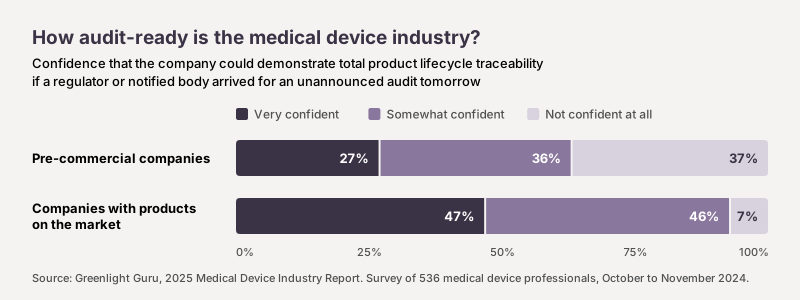
Asked how confident they were that they could demonstrate total product lifecycle traceability if a regulator or notified body arrived for an unannounced audit tomorrow, only 27% of pre-commercial companies said they were “very confident”. Among companies with products on the market, the figure was 47%.
The Challenges: One Product, Several Versions of the Truth
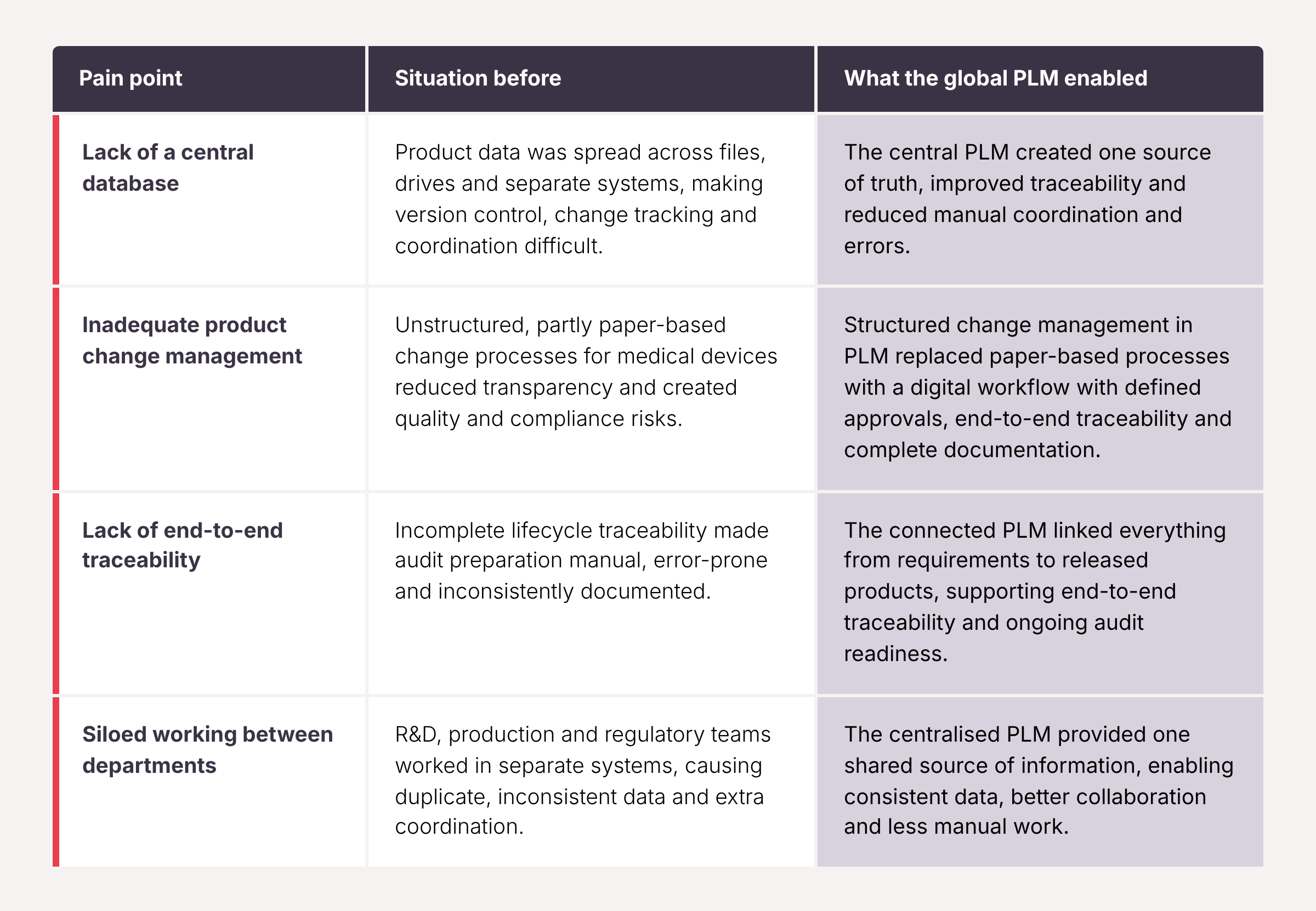
The client faced many of the same challenges. With each site running its own PLM system, the same part could exist in several versions, with different numbers and revision histories. Changes were partly handled on paper, requirements and test results sat in separate tools, and R&D, production and regulatory teams each worked with their own data.
Here are the four main pain points, and what the global PLM has changed at the sites already live:
The Ambition: From Data Silos to a Single Source of Truth
By centralising product data, PLM creates a single source of truth across product information, changes and connected systems such as enterprise resource planning (ERP), computer-aided design (CAD) and manufacturing execution systems (MES).
Beyond compliance, the value is very practical. Teams spend less time fixing inconsistent data. Changes move through the organisation more smoothly, and people can work from the same information instead of reconciling different versions.

From the Project Lead: The Cost of Standing Still
“A PLM transformation is never trivial. It touches processes that have grown over years, roles people are used to, and systems every site has learned to work around. It’s tempting to postpone it. But standing still has a cost too: every audit still means rebuilding traceability by hand, every shared part still exists in several versions, and the compliance risk grows with each new regulatory requirement. Going live site by site showed us that once teams work from one source of product data, nobody wants to go back.”
Florian Alsheimer-Baldeón, Senior Consultant PLM Digitalisation, Arcondis
Our Approach: Analyse, Standardise, Roll Out Wave by Wave
Our contribution focused on three areas: understanding the barriers, creating a common approach and supporting implementation and adoption.
1. Analyse: Making the Barriers Visible
We started by looking at where the existing PLM setup was creating the biggest problems. Together with teams from R&D, quality, regulatory affairs and operations, we traced how product changes moved through the organisation and found that many were still handled on paper. We also saw that requirements, risks, design and test results lived in separate tools, making traceability a manual effort before every audit, and that sites maintained their own versions of shared product data. These findings helped us understand where action was needed first.
2. Standardise & Integrate: Creating a Common PLM Approach
Building on these findings, we designed a harmonised PLM approach across all sites. Change management was moved into a structured, digital workflow with defined impact analyses, approval steps and complete documentation. Requirements, risks, design, and verification and validation were linked within PLM, and key systems such as ERP, MES and CAD were connected to it. With clear ownership of product data, PLM became the shared system that teams at the live sites can rely on.
3. Implement & Improve: Rolling Out and Learning Wave by Wave
We brought the new approach into the organisation step by step, starting with pilot sites to prove its value and refine the template. Rather than switching all sites at once, the roll-out then moved in waves, starting where the value was highest and the path clearest. Sites that share parts and components went live together, so product data stayed consistent from day one and no one had to bridge old and new systems in the meantime. Each wave was prepared, brought live and closely supported through hypercare. After go-live, we tracked adoption and process performance and used the lessons from each wave to refine the global template before the next one began.
Going live is only half the job: people also need to be ready to work in a new way. Users were involved early, leaders set the direction and key users helped shape the solution. At every site, local champions acted as the first point of contact and helped translate the change into day-to-day work. To support the roll-out across the sites, we focused on three practical areas:
- Organisational change management (OCM): We tailored communication to the different user groups, so people understood what was changing, why it mattered and what it meant for their work.
- Demos and hands-on sessions: Live demos and interactive sessions on the test system let users experience the new tool first-hand, making the change tangible and increasing acceptance before go-live.
- Access profile assignments: We mapped each person’s current tasks and responsibilities to the relevant roles in the global PLM system, digitising existing processes and supporting a smooth transition from day one.
Together, these activities helped prepare users for the new system and made adoption part of the roll-out rather than something addressed only at go-live.
The Results: Six Sites, 370 Users, One System
At the six sites in three countries that are already live, around 370 users now work in the global PLM system, and one legacy PLM system has been decommissioned. Paper-based change processes have been replaced by a digital workflow, so every change follows the same defined steps and leaves a complete, traceable history from request to release. Because requirements, risks, design, and verification and validation are linked in one system, traceability no longer has to be assembled manually before each audit. Shared product data is maintained once and used consistently across the connected sites, reducing the effort and errors caused by parallel local versions. Teams also share a common way of working and a common understanding of how changes are handled across sites.
The remaining sites will follow in the next roll-out waves. Each wave builds on the refined global template and the lessons learned so far, so that over time all sites will work on one harmonised PLM foundation with the same level of control and transparency.
Your Next Step: How Mature Is Your PLM?
Facing similar challenges? Our PLM maturity assessment helps identify where your organisation stands today, where the main gaps are, and where it makes sense to focus first. Contact us to arrange a PLM maturity assessment for your organisation.