

Whitepaper: Rethinking Swiss Health Insurance
Rethinking Swiss Health Insurance
Luca de Angeli (Author), Denis Sonic (Co-Author) and Fabia Fricke (Co-Author), Arcondis AG
Swiss healthcare business sustainability is at risk: by 2030, c.a. 30% of the Swiss population might struggle to pay their mandatory insurance premium. The consequences could be serious, including a deep reshuffle of the current health ecosystem, in which health insurers play a pivotal role.
While containing costs might require structural reforms on how health services are managed and reimbursed, a shift from an illness-centered system into a prevention-driven model would help address this conundrum.
Health insurances can play a central role in driving this transformation: building trust and partnership with their customers, moving into an all-in data donation game.
From a dinner for 3 to a party of many
If almost any healthcare system in the world could be modeled as a ‘dinner for 3’, having a patient eating a dish chosen by a physician that a payer will pay, when it comes to the Swiss one it seems that a ‹party› might be the most appropriate description. The Swiss healthcare system compares well with those of other OECD countries. It has universal health insurance coverage, allowing access to a broad range of modern medical services, and patients are largely satisfied with the healthcare they receive.
It is a mixture of state control and free competition:
- Private health insurance companies operate on a highly regulated market
- Service providers such as doctors and hospitals are partly private and partly state-owned
- In addition, the cantons are responsible for health care, however some issues are governed by national law.
This complexity, along with less-than-optimal cost effectiveness measures (i.e. fee-for service or by number of bed days) do not provide strong incentives to increase cost-efficiency. This results in the second most expensive healthcare system in the world, second only to the the American one.
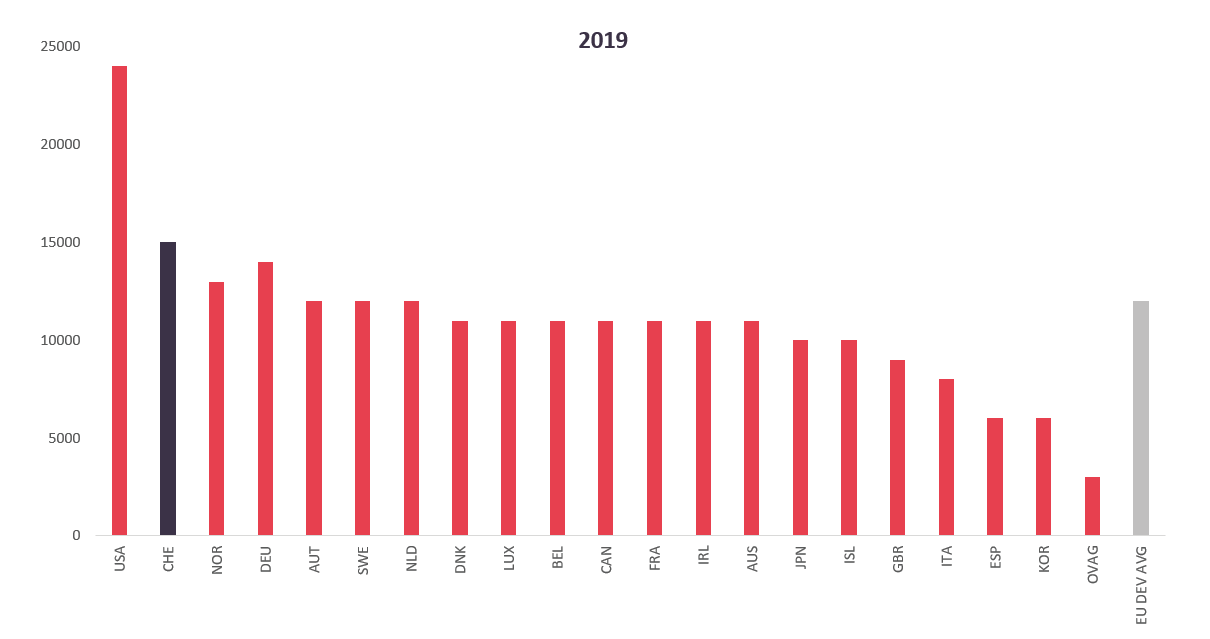
World Healthcare per capita spending 2019 (source: OECD)
In addition, Swiss costs are growing faster than the European average, mainly driven by inpatient costs, and showing a lower-than-average spend on preventive care (2% VS UE avg above 3%, 2018, OECD). This trend is not expected to turnaround due to an ageing population and chronic diseases rising.
1. The Cost: Who pays for it?
All persons domiciled in Switzerland must take out compulsory basic health insurance and pay monthly health insurance premiums of their choice. This creates some competition between insurance companies, whose premiums vary depending on the canton of residence. Those who find it difficult to make ends meet can request a reduction in premiums.
Health insurance companies are obliged to provide basic insurance for everyone, including the sick and the elderly. As for supplementary insurance, they can refuse the affiliation request.
Monthly premiums are a key variable to be considered when investigating cost distribution: in 16 years premiums doubled. In relation, the salary only increased by 22%.
Should this trend continue and all other things being equal, there is a significant risk that in 2030, 30% of the Swiss population could not afford to pay the compulsory insurance vs the current 8%.
What might happen under this scenario:
- Creation of separated healthcare systems with differentiated access?
- Pricing rules change (with potential impact on therapy access)?
- A single compulsory insurance operator?
Structural changes are pushing the current system to its limits. To a certain extent, the Swiss Healthcare System is ill and the question is: who is going to take care of it?
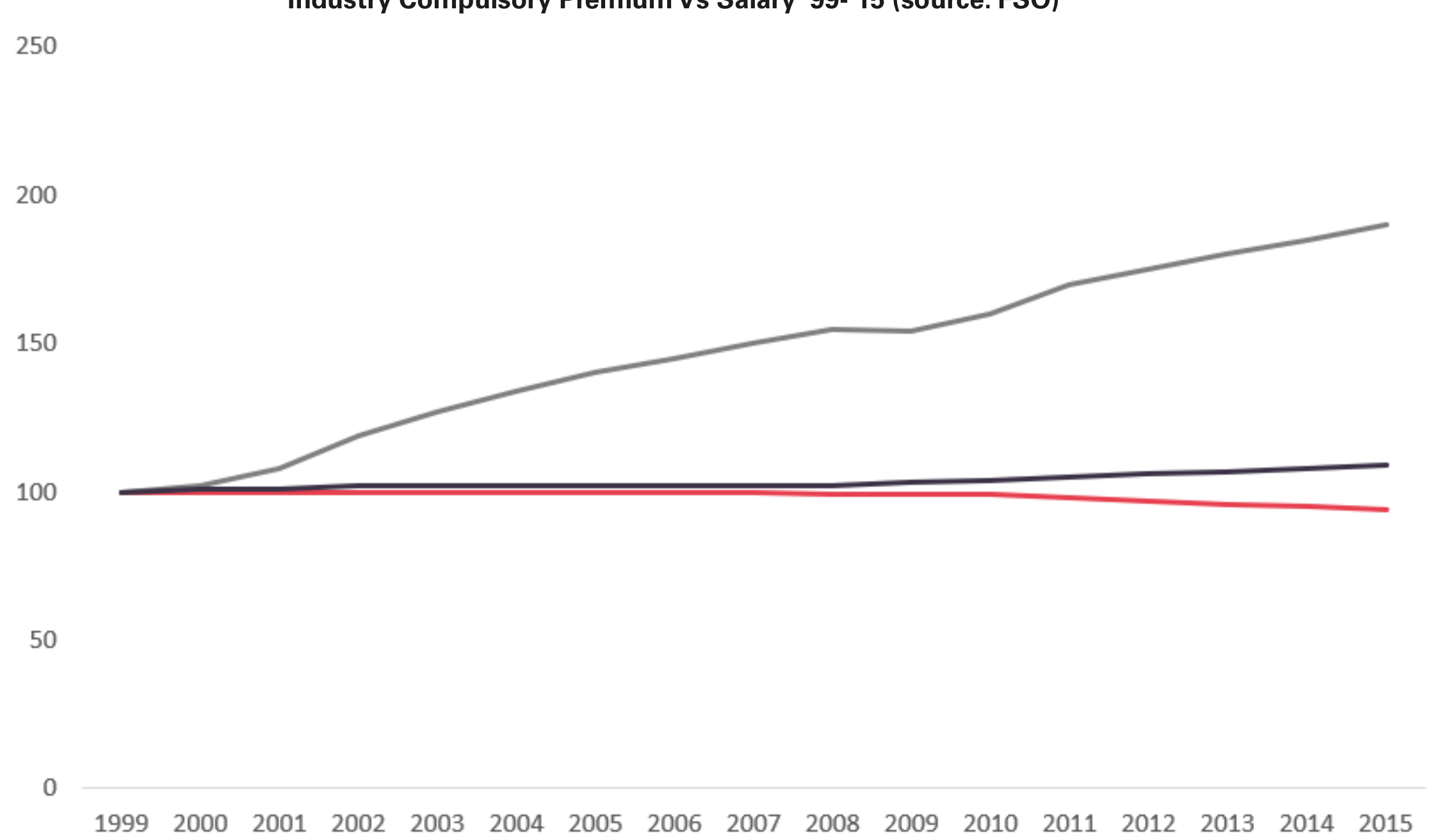
Industry Compulsory Premium Vs Salary ‘99-’15 (source: FSO)
There is a significant risk that in 2030, 30% of the Swiss population could not afford to pay the compulsory insurance.
2. Health Insurers: Do not ask for whom the bell tolls. It tolls for you
With constant healthcare rising costs escorted by the increase in upfront premiums e.g. COVID-19 or automation, there is a serious question of sustainability: how long can the premium keep on rising?
With a current volume of reserve of 11 MLD (FSO), circa double that required by law, health insurance companies in Switzerland are relatively protected from further system cost increases. Yet, refusing to investigate how to face the future might reveal itself to be a serious strategic mistake.
The current business model is purely based on “insurance”: built upon the coverage of health risks and measured as the probability of getting ill. How might health insurers are already anticipating future scenarios?
We see 3 strategic options for insurance providers:
Three strategic options for insurance providers
1) Business as-is
Encompassing a constant premium increase, potentially mitigated by a targeted use of reserves, i.e. support direct investments in primary care and/or returning money to customers. This is not sustainable. 30% of the population is struggling to pay for their compulsory insurance premium, with a 13% increase in costs year after year, putting the system at risk.
2) Cost effective strategies
Limiting the rise in premiums by pursuing aggressive cost-cutting strategies, which might include an empowerment of underwriting efficiencies addressing inorganic growth/outsourcing. The Swiss health insurance market is consolidating, with 5 out of 53 companies making up 50% of the market share. Acquiring critical mass will not fix long term challenges, but could unlock funds to finance innovation.
3) Data donation
Building trust and partnering with clients to drive a deep shift in the healthcare system in favor of preventive care: partnering with and helping patients navigate the complexity of the Swiss healthcare system while tailoring ad hoc preventative care based on each customer’s health risk profile will result in dramatic and sustainable long-term change.
3. From blood donations to data donations
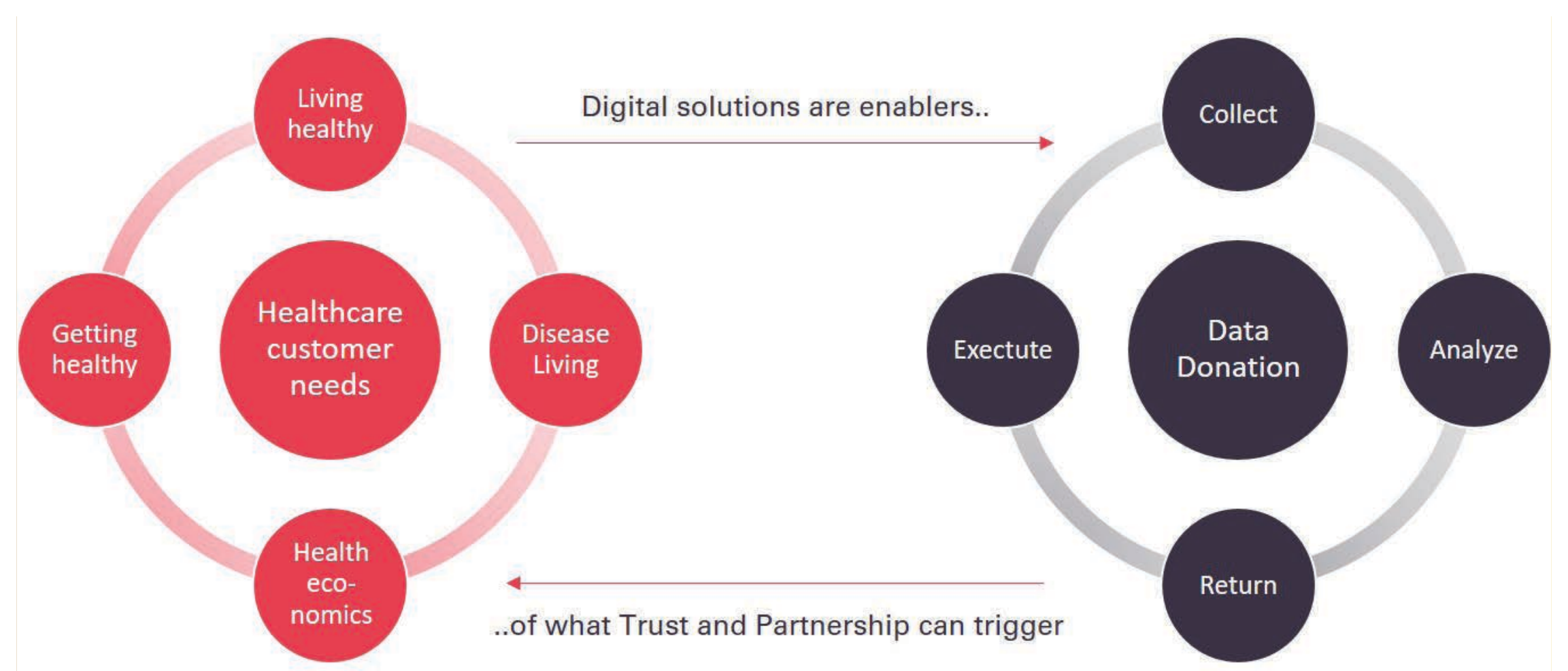
Leveraging digital solutions to become the health value partner
Health insurances need to challenge the current status quo and rethink the way they deal with their customers to move into what can be defined as “the health value partner”.
The key is to transform health insurances in data driven companies: a major cultural transformation, which is far broader than a simple digital one:
- Data donation: collecting data, profiling customer’s health risks.
- Data analysis: analyzing the results, developing customized preventive health pathways.
- Moving into execution: empowering customers navigating the healthcare system
Learning by doing will help to discover effective treatments and best prevention care for individual customers. Furthermore, this could lead to a delay in disease onset, prolonged quality of life and increase in funds to finance innovative medical treatments.
4. Digital technology
It is nothing without trust and partnership
To develop and execute a Data donation strategy, health insurers cannot simply become digital: they need to build trust and partnership with their clients. And this requires knowing your customer and understanding their needs, their journey and their experience to transform what you offer and how you assist them.
As confirmed by Aetna, Kaiser Permanente in the US, as well as in Switzerland, customers would be keener to share their data, if offered something in return:
- Kaiser Permanente experimented a shift from an initial 20% to a 75% of customers’ engagement and commitment to share data by having introduced personalized solutions and offers.
- In Switzerland, the first reason why customers are not committed to sharing data with their insurers is the lack of benefits (43%), while privacy represents only 21% of reasons given (source Arcondis).
The challenge is based on winning the healthcare trade-off: developing attractive and customized solutions while ensuring their sustainability. To get there, a deep transformation and multidimensional journey must be pursued:
A deep transformation and multidimensional journey
1. Business
A shift from 1: n to 1:1, i.e. projecting and releasing a truly unique customer experience tailored to each customer journey, in which the insurer walks hand-in-hand with the customer.
2. Regulatory
There is a general perception of a potential ethical issues offering health insurances a crystal-clear visibility each customer health risk profile might generate hazard behaviors. Here authorities and health insurances should partner to grant full coverage as well as continuous investment into medical innovation.
3. Technology
Health insurances cannot do it all by themselves. The key to success will depend on fully leveraging the ecosystem, partnering to scout the most suitable technology solutions, and engaging with partners able to seize the opportunity.
4. Organization
It is nonsense to collect data if you do not know how to use it effectively. To close this loop you need an organization which can project the customer’s voice and is committed to continuous improvement.
5. Cultural
From aversion to risk, health insurers need to move in the opposite direction: embracing their customers’ journeys, partnering with all healthcare stakeholders, and becoming the drivers of a change that with every passing day appears to be more and more in demand.
By leveraging digital solutions and social marketplaces, health insurance can significantly transform their business, dramatically improving the customer journey: this will generate a better cost optimization while increasing loyalty.
5. The way ahead
An old saying goes:
«Without health, there is nothing»
Unfortunately, in today’s Swiss healthcare system, it is getting seriously difficult to materialise this. Paradoxically, to avoid a cost increase, prevention exams are usually skipped, just to mention a common approach from many GPs. For instance, in Italy a mammography is recommended for women turning 40, while in Switzerland the recommended age is 50. What could be discovered in those 10 years and how many lives and costs could be saved?
Today the words of the poet John Donne resound even more than yesterday:
‘No man is an island entire of itself; every man is a piece of the continent, a part of the main; if a clod be washed away by the sea, Europe is the less, as well as if a promontory were, as well as any manner of thy friends or of thine own were; any man›s death diminishes me, because I am involved in mankind. And therefore, never send to know for whom the bell tolls; it tolls for thee’.
If we really want to make healthcare better, now is the time to work together to transform the way we serve customers, partner with healthcare givers and fully leverage the ecosystem by building the future to come.
How our experts can support you
- We help you build the ecosystem
- We develop the digital factory
- We transform the organisational culture and operating model
Contacts:
- Luca de Angeli (Author) – Healthcare Expert, Arcondis AG
- Denis Sonic (Co-Author) – Insurance & Pharmalogical Innovation, Arcondis AG
- Fabia Fricke (Co-Author) – Healthcare, Molecular Cancer Research, Business Analysis, Arcondis AG