


Opinion: Gen AI for Pharma Content: Own It or Outsource It?
Gen AI for Pharma Content: Own It or Outsource It?
Opinion by Felix Evensen, Principal, Digital Engagement & CX, Arcondis
It became quite clear in 2024 that the integration of generative AI (Gen AI) across the pharma content value chain presents significant opportunities to transform content-related processes. But transformation is rarely a straight path.
As the pharma industry grapples with balancing brand promotion and delivering valuable content to healthcare professionals (HCPs) – all while adhering to strict regulatory guidelines – Gen AI tools can indeed help. However, despite the “AI-euphoria” over the past two years, reality has been more complex than anticipated. Recent analysis of Gen AI adoption in the pharma customer engagement space suggests that implementing scalable and effective solutions remains challenging.1 However, the critical question isn’t if Gen AI should be adopted but how? Should you consider in-sourcing and owning a larger proportion of the content value chain, supported by Gen AI solutions? Or should you continue to outsource and rely on external agencies (who are already applying Gen AI – for better and for worse)?2
Let’s explore the “in-source vs outsource” challenge across the pharma content value chain, revealing opportunities and risks at every stage.
Download this Article as a PDF
The question isn’t IF Gen AI should be implemented to transform content creation processes in the pharma content value chain, the question is HOW.
DEFINING THE PHARMA CONTENT
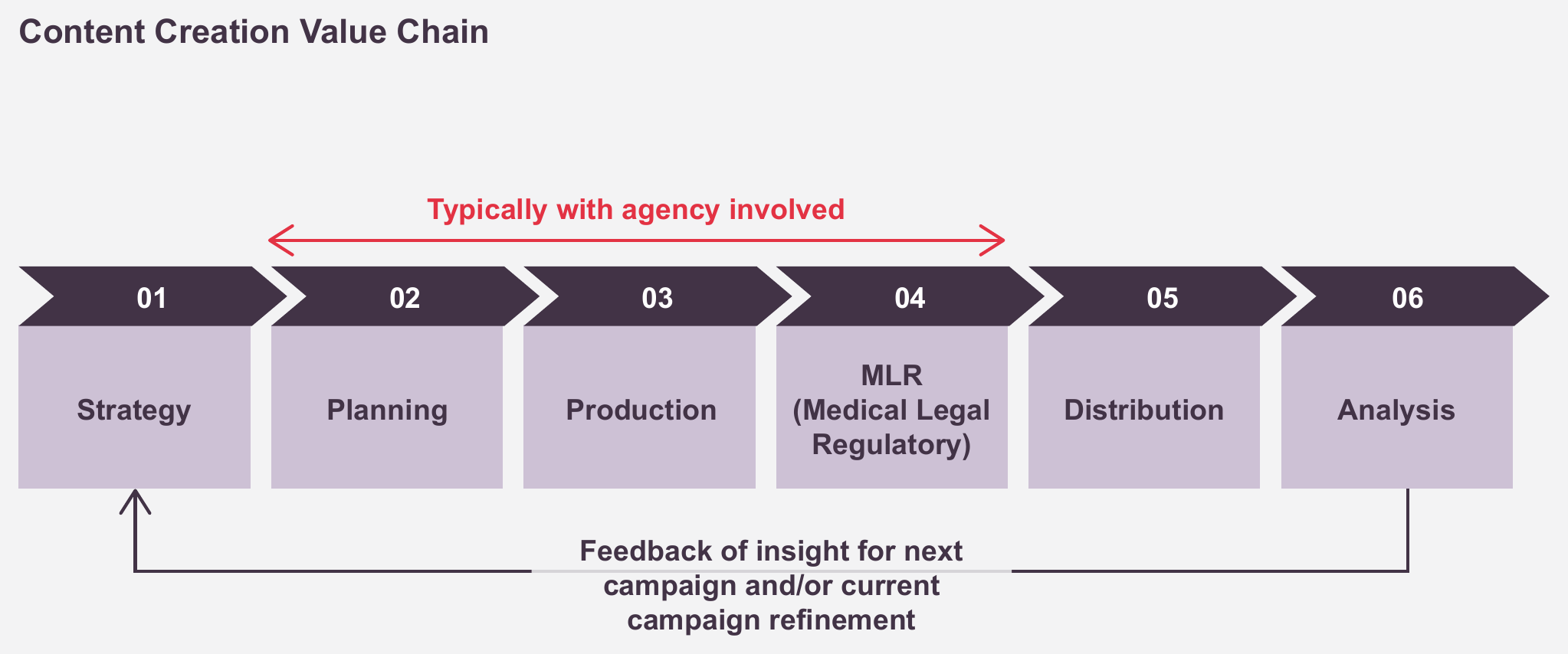
For the purpose of this analysis, we define the pharma content value chain as six stages (see diagram below).
While we certainly believe that Gen AI tools can be applied to and assist with Strategy and Planning, we see more immediate opportunities and applications with Production (creation), the Approval process (Medical Legal Regulatory – MLR), Distribution and Analysis. So let’s dive in, starting with a closer look at Gen AI for Content Production.
CONTENT PRODUCTION: IN-SOURCE FOR CUSTOMISATION, OUTSOURCE FOR MOMENTUM
Gen AI tools have demonstrated remarkable capabilities in content generation across text, imagery, audio, and video. And even going a step further, coding and formatting content for the designated purpose / channel. For example, specialised tools can convert Microsoft Office documents into various designated formats, such as webpage code for WordPress or email code for Salesforce Marketing Cloud. For global and local brand teams, this means faster ideation, quicker localisation, and better adherence to regulatory frameworks. The decision to internalise or externalise will define the agility of your organisation.
In-source
Developing internal adoption of Gen AI tools tailored to brand needs ensures tighter control over content quality, regulatory alignment, and brand voice. Fine-tuned models trained with proprietary data can produce hyper-relevant outputs – compliant by design. For example, a global brand team might use an in-house AI model to generate product descriptions in multiple languages that are pre-checked against the Summary of Product Characteristics (SmPC).
Outsource
Agencies have been quick to embrace the opportunities that Gen AI offers, and have full liberty to test and experiment with any tool available. Accordingly, they are ahead of internal staff when it comes to experience with what tools to apply and how to best apply them. However, outsourcing created a costly dependency for updates and innovations, and highly valuable knowledge remains outside your organisation.
Our recommendation
The content production process at pharma companies is already mostly outsourced, with internal efforts limited to minor “tweaks”. At this stage, we recommend that you start internal upskilling on Gen AI content creation solutions and approaches immediately. A hybrid approach – working with agencies to build up internal solutions and transferring knowledge – allows you to stay agile without sacrificing long-term control. Over time, we expect to see a significant increase of in-house created and localised content, versus the significant level of outsourcing that is still prevalent.
REVIEW AND APPROVAL: IN-SOURCE FOR EVOLUTION, OUTSOURCE FOR CAPACITY
The pharma MLR process is generally considered to be notoriously slow and labour-intensive, and is seen as the most significant bottleneck in pharma content creation. Here, Gen AI shines by automating repetitive tasks like metadata extraction, flagging compliance risks, and pre-checking content against SmPCs and past approvals. But the stakes are high; errors in compliance can lead to costly penalties and reputational damage.
In-source
Using Gen AI-powered solutions integrated with platforms like Veeva Vault Promomats assisting with compliance scanning, submissions for compliance can be rechecked, issues flagged and metadata extracted automatically. In-sourcing this work means teams retain control over compliance and builds familiarity with regulatory nuances. For example, a team using in-house Gen AI can ensure every piece of content aligns with SmPCs and approved claims before the first MLR meeting, reducing delays. As for the review side of the process, Gen AI “copilots” can assist the review teams by immediately flagging potential issues, and thereby help reduce the workload and speed up the review process.
Outsource
Because the submission process is often cumbersome, it is not uncommon for brand teams to outsource this work to their content agencies. This can be helpful for teams lacking internal capacity, typically in smaller markets. However, as we expect the content creation itself to increasingly be done in-house, so will the Gen AI-supported submission process. Content creation means content knowledge, which goes hand-in-hand with the content submission. And due to the critical nature of the review itself, this will remain internal, with or without AI enhancements.
Our recommendation
The review stage is too critical for pharma companies to rely on third-parties (or AI), and the final decisions will remain in-house and human-centered. However, there is a significant opportunity for you to apply Gen AI in the MLR process, both for submission and review, reducing time and efforts required per tactic, and thereby increasing capacity. We believe this is perhaps the most critical area of the content value chain to enhance with Gen AI, and we would encourage you to start building up capabilities and competence in this area immediately.

CONTENT DISTRIBUTION: IN-SOURCE FOR OWNERSHIP, OUTSOURCE WHEN NEEDED
Gen AI’s ability to generate personalised content variations is well-established, making it possible to move from “one-size-fits-all” to “one-size-for-each” content strategies. Traditional AI (i.e., machine learning) can also help enhance content distribution by segmenting audiences with high precision, ensuring that the right message reaches the right person at the right time.
However, the challenge lies in aligning this level of customisation with the speed of regulatory review. Until the approval process for personalised content is streamlined, the one-size-fits-all (or many) approach will persist, especially in smaller markets with limited resources for granular targeting.
In-source
Internal teams equipped with Gen AI-driven personalisation tools like Salesforce Einstein or Adobe Experience Cloud can segment audiences and deploy tailored content at scale. The application of AI for next-best-action is already well-established in many companies, allowing for a more targeted and personalised engagement approach. Furthermore, keeping distribution internally allows full retention of customer insights and engagement data.
Outsource
Agencies specialising in content distribution can provide a shortcut for testing personalisation strategies. They are especially useful for smaller markets where resources are limited, or when launching campaigns with rapid turnaround requirements.
Our recommendation
Other than third party platforms and external distribution lists, content distribution will largely remain in-house. Some of the activities might be outsourced for capacity, but the tools and platforms used should be internally integrated with your CRM. This will allow engagement data to be accumulated and analysed (by AI), allowing deeper customer insights, improved next-best-action recommendations and improved segmentation. Ultimately, this will enable you to be more customer-centric, providing your customers with a more personalised customer experience.
PERFORMANCE ANALYSIS: IN-SOURCE FOR COMPETITIVE EDGE, OUTSOURCE FOR CONVENIENCE
While not directly related to Gen AI, performance analysis is an area where AI – in particularly machine learning (ML) – has already made significant contributions. AI-driven tools can analyse vast datasets, providing insights into content performance and enabling continuous improvement. As more user-friendly, i.e., less “techie” analytics platforms emerge, content creators will become less dependent on data specialists, allowing for more immediate and actionable insights to inform future content strategies.
In-source
In-sourcing analytics with user-friendly platforms will enable teams to develop a nuanced understanding of what works – and why. By embedding AI into analysis workflows, internal teams are empowered to act on insights faster, without waiting for agency-generated reports.
Outsource
Outsourcing analytics to agencies or data vendors may be tempting for companies lacking internal expertise, but it comes at a cost. Agencies often package standard insights with little room for customisation, and it can also lead to the common “what-you-see-is-all-there-is” fallacy.
Our recommendation
Build and expand your internal analytics capabilities for deeper, faster insights that drive competitive differentiation. Outsource only if internal resources are unavailable, and prioritise tools that allow you to transition to in-house ownership over time.
CONCLUSION: THE FUTURE OF PHARMA CONTENT IS GEN AI-DRIVEN
Gen AI solutions are starting to become an integral part of the pharma content creation value chain, improving processes from production to review, distribution, and analysis. While “pilots” and various “initiatives” are found scattered across the industry as well as on the agency side, globally scaled success stories are rare. Nevertheless, the Gen AI revolution is making it feasible to internalise work that is still largely the domain of agencies. Based on Arcondis client work, research and estimations, we believe that companies can reduce their content-related costs by as much as 40% by applying Gen AI solutions and moving most of the content value chain internally.
By building internal capabilities with vetted and approved tools, you reduce costs, increase efficiency, build up in-house skills and maintain control. Please contact me if you would like to discuss the integration of Gen AI across the pharma content value chain. Our team of customer engagement specialists and AI experts will assist you from concept-definition to implementation.
In the words of William Gibson
The future is already here – it’s just not evenly distributed.
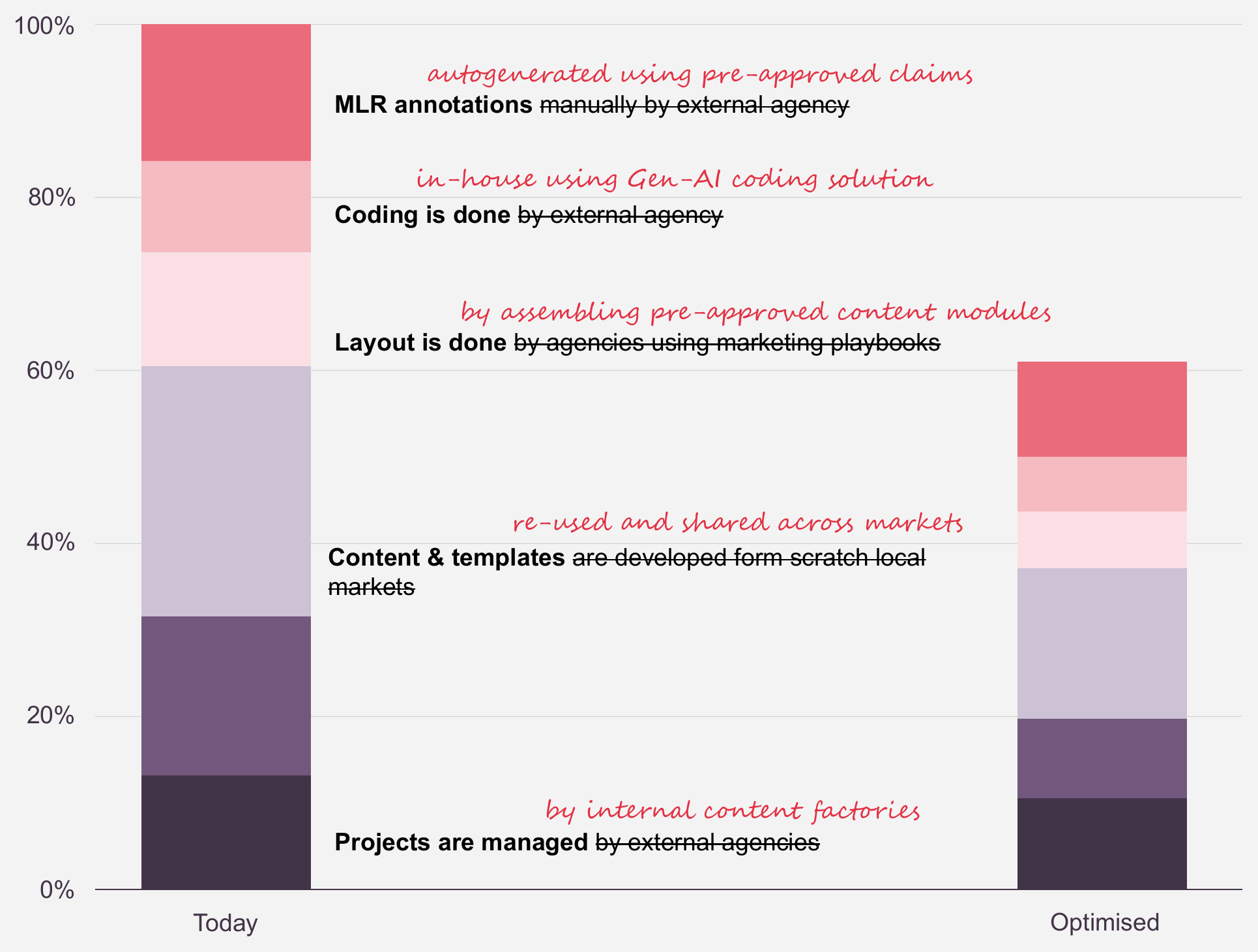
Before: 100% – After: ~60%
References
- Arcondis research Q3-Q4 2024
- Forbes – Coca Cola’s AI-Generated Ad Controversy, Explained
- Veeva AI Partner Program
- Wikipedia – Thinking, Fast and Slow – Daniel Kahnemann
- The Economist – Broadband Blues
About the author
Felix Evensen, MS Engr, MBA
Principal, Digital Engagement & CX
felix.evensen@arcondis.com
+41 79 540 56 91
Felix Evensen is a Principal Consultant in Arcondis’ Digitalisation of Customer Engagement practice. In this role, he helps clients shape strategies and processes for the digital transformation of their go-to-market models. With more than 15 years of pharma experience from both global and local roles, he provides expert insights and knowledge that help deliver effective digital solutions.