
Opinion: Enabler or Obstacle? The Dual Role of Leadership in Organisational Change.
Enabler or Obstacle? The Dual Role of Leadership in Organisational Change
Opinion by Matthias Obert, Organisational Change Management Consultant & Account Lead, Arcondis
Leadership will either drive transformation or become its greatest barrier. Across every level – senior, middle and front-line – leaders hold the power to accelerate progress or bring it to a halt.
Leadership is the #1 success factor in change and the #1 reason why it fails.
This paradox lies at the heart of why so many organisational transformations – up to 70%, according to McKinsey – end in disappointment, derailment or quiet abandonment (McKinsey & Company, 2015). From failed digital transformations to misfired agile rollouts, organisations repeatedly invest in tools, processes and consultants only to find their efforts stall not because of technology or resistance from the front lines, but because of leadership misalignment.
Download this Article as a PDF
Leadership is the #1 success factor in change and the #1 reason why it fails.
But leadership isn’t a single, uniform force. It’s made up of different layers and each layer plays a distinct, vital role in driving or derailing change. When top executives set bold visions, but middle managers hesitate, or when team leads are expected to “champion change” without clarity or support, transformation stalls in a fog of uncertainty. The very people who are supposed to lead change inadvertently become their most subtle saboteurs.
LEADERSHIP AS A HIDDEN BARRIER
Leadership is expected to be the engine of transformation – yet it often functions more like the brake. Why?
Because misalignment between layers creates invisible bottlenecks. Top management may speak of innovation and agility, but if their day-to-day decisions and incentive systems reward risk-aversion and short-term performance, the message is clear: don’t change. This “say-do” gap is especially dangerous in highly regulated industries like life sciences (pharma, MedTech and public health), where compliance and stability are prized – often at the expense of speed and experimentation.

Middle management often bears the brunt of this paradox. As Harvard Business Review (2016) describes it, the “frozen middle” can either thaw or freeze transformation. Overloaded, under-empowered, and caught between strategic vision and operational demands, they are rarely given the time or support to translate change into local reality.
According to Prosci (2024) middle management is also the group most resistant to change but also the most important group to address. Research shows that a majority of this resistance can be mitigated by thoroughly addressing this group in the change plans.
According to Schein’s organisational culture theory, cultural resistance often surfaces not in formal objections, but in the quiet persistence of old routines (Schein, 2010). When change isn’t mirrored by leadership behaviour or if cultural norms remain unaddressed, people default to what’s safe and familiar. And that inertia, particularly in hierarchical sectors like pharma, can be incredibly difficult to dislodge.
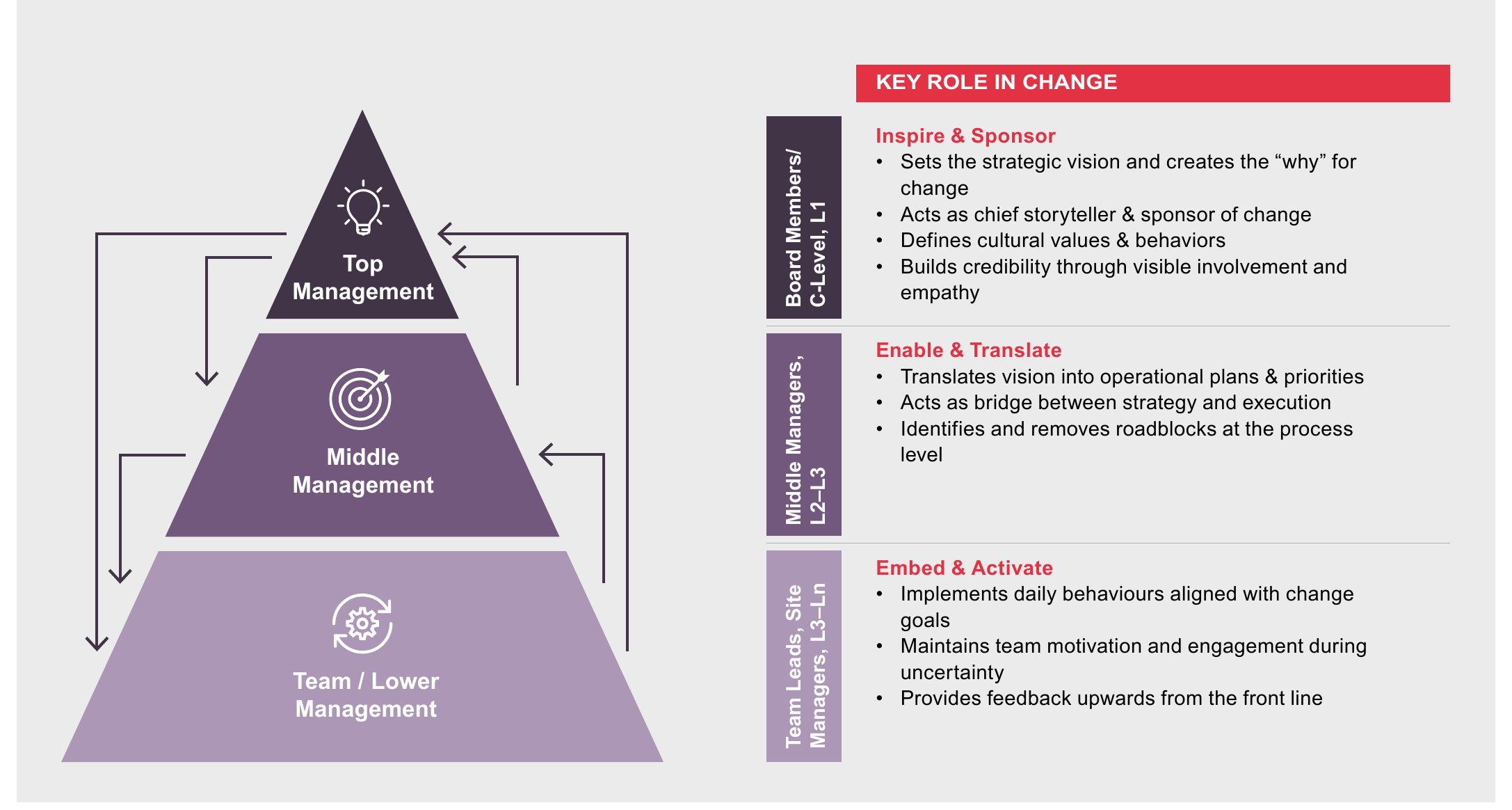
Figure 1: Leadership Levels & Roles
THE LEADERSHIP STACK – ROLE DIFFERENTIATION
To unlock transformation, organisations must understand and activate the full leadership stack — each layer playing its unique role, like instruments in a change orchestra. When one section is out of sync, the music fades or wanes.
Transformation doesn’t fail in strategy rooms. It fails in the daily stand-up, the shift changes and the hallway conversation.
EXECUTIVES – THE VISION DRIVERS & SPONSORS
Executives set the tone. They define the “why” of transformation, signal priorities, allocate resources and role-model desired behaviors. Their influence is symbolic and systemic — what they say in town halls matters, but what they reward and tolerate matters more.
When top leaders only offer rhetorical support without embedding change in systems (like incentives or governance), the result is symbolic alignment, a vision with no follow-through. Kotter’s 8-Step Model stresses the need for visible short-term wins and consistent leadership modeling (Kotter, 1996). Likewise, Gartner reports that culture, shaped heavily by leadership, is the number one reported barrier to digital transformation (Gartner, 2020).
MIDDLE MANAGEMENT – THE TRANSLATORS & MULTIPLIERS
Middle managers are translators of strategy. They localise high-level visions, buffer teams from chaos and multiply (or dilute) the impact of change. But they are often the least supported during transformation. According to HBR, they suffer from role uncertainty, information asymmetry and workload overload — leading to disengagement or passive resistance (Harvard Business Review, 2016).
A BCG study found that middle managers are also key to cultural reinforcement. Their informal leadership, including hallway conversations, project decisions and mentoring moments, shapes how change is perceived and enacted (BCG, 2021). If middle managers are not explicitly engaged and aligned, change becomes “someone else’s initiative.”
Pharma organisations frequently task medical affairs managers or regulatory leads with transformation roles — on top of their day jobs. Without clear mandates, capacity relief, or leadership coaching, they struggle to act as effective multipliers.
In our project work we have observed how organisations often underestimate the need to obtain buy-in from middle management, assuming that they will “just do their job and support the change”, while many may be disassociated from it or even actively oppose it.
In addition, we have seen that they don’t always have the tools or understanding to lead in times of change and that they are unable to manage upwards or lead by example in the face of strong opposition from team members. This typically includes the lack of the ability to handle resistance, bringing key issues to the attention of senior management and to find solutions to legitimate concerns.
TEAM/LOWER MANAGEMENT – THE ACTIVATORS
First-line managers and team leads activate change on the ground. They operationalise new workflows, coach new behaviours and absorb frontline feedback. They are closest to daily realities and their credibility with teams is crucial.
But they are often the least informed about strategic intent. Communication breakdowns mean they receive diluted, delayed, or overly technical messaging. This creates confusion and frustration. Without clear support, they become reluctant participants or disengaged executors.
Imagine a lab supervisor in a pharma manufacturing site being told to implement “agile principles” without context. Without a shared understanding of what agility means in a regulated Good Manufacturing Practices (GMP) environment or how performance will be measured differently, they default to familiar protocols. Transformation doesn’t fail in strategy rooms. It fails in the daily stand-up, the shift changes and the hallway conversation.

REFRAMING LEADERSHIP FOR CHANGE SUCCESS
To avoid the trap of symbolic change, organisations must reframe leadership, not as a static role, but as a dynamic system. One that must be built, aligned and continuously adjusted.
1 Invest in leadership capability building
Leadership for transformation requires different muscles: systems thinking, emotional intelligence and adaptive communication. Pharma companies like Roche have invested in enterprise-wide capability programs to develop change leadership as a core competency, not a side project (Leadership Circle, 2021).
2 Align incentives and KPIs
What gets measured gets managed and mimicked. If leaders are judged solely on legacy metrics, they will not prioritise transformation. Instead, they need to tie incentives to transformation outcomes, cross-functional collaboration and culture-building behaviours.
3 Create cross-level feedback loops
Real alignment requires listening upwards as much as cascading down. Establish safe, structured spaces for dialogue between leadership layers, not just reporting lines, but reflective forums. This allows early detection of misalignment, misunderstanding and resistance.
As Springer’s research on change readiness highlights, successful transformation depends not just on strategic clarity, but on the organisation’s collective ability to adapt – a function of both culture and capability (Springer, 2019).
Leadership is either the greatest enabler or the most subtle blocker of transformation, often both at once.
CONCLUSION: A CHECKLIST FOR LEADERSHIP ALIGNMENT
Change doesn’t fail because people don’t want to change. It fails because leadership in all its layers, fails to pull in the same direction, at the same time, with the same clarity.
In the life sciences world, where precision, compliance, and complexity intersect, this alignment is both harder and more critical.
Before launching your next change or transformation initiative, ask:
- Does top leadership lead the change they speak about?
- Are middle managers equipped and empowered to translate strategy into action?
- Do team leaders understand the “why” and feel supported to activate new behaviours?
- Are incentives aligned across layers to reinforce the change?
- Is there a feedback mechanism that allows friction points to surface and addressed?
If the answer to any of these is “no,” transformation will face resistance. Not because people oppose it, but because the system isn’t aligned to support it.
Arcondis’ Organisational Change Management (OCM) services are designed to facilitate smooth transitions across all levels in the organisation and to ensure leadership adoption and capability building.
Our advice is to audit your leadership stack. Don’t just ask if you have the right strategy. Ask if your leaders at every level are truly ready to deliver it. Because in transformation, leadership is not just part of the solution. It is the solution or the silent reason for failure.
Contact me if you would like to discuss our OCM services and how we can help you, in more detail.
References
- BCG (2021) How Middle Managers Can Drive Cultural Transformation. [online] Boston Consulting Group. Available at: bcg.com [Accessed 27 May 2025].
- Gartner (2020) Culture Is the Top Barrier to Digital Transformation. [online] Gartner, Inc. Available at: gartner.com [Accessed 27 May 2025].
- Harvard Business Review (2016) The Frozen Middle: Why Organizations Don’t Change. [online] Harvard Business Review. Available at: hbr.org [Accessed 27 May 2025].
- Kotter, J.P. (1996) Leading Change. Boston: Harvard Business School Press.
- Leadership Circle (2021) Roche Case Study: Leading with agility. [online] Available at: leadershipcircle.com [Accessed 4 Jun. 2025].
- McKinsey & Company (2015) The People Power of Transformations. [online] McKinsey & Company. Available at: mckinsey.com [Accessed 27 May 2025].
- Prosci (2024) Best Practices in Change Management. Available at: prosci.com
- Schein, E.H. (2010) Organizational Culture and Leadership. 4th ed. San Francisco: Jossey-Bass.
- Springer, C. (2019) Organizational Change Readiness: The Key to Effective Transformation. Journal of Change Management, 19(3), pp.150–167. doi.org